Building a Team of Engineers: From GitHub Issues to Small, Reversible PRs
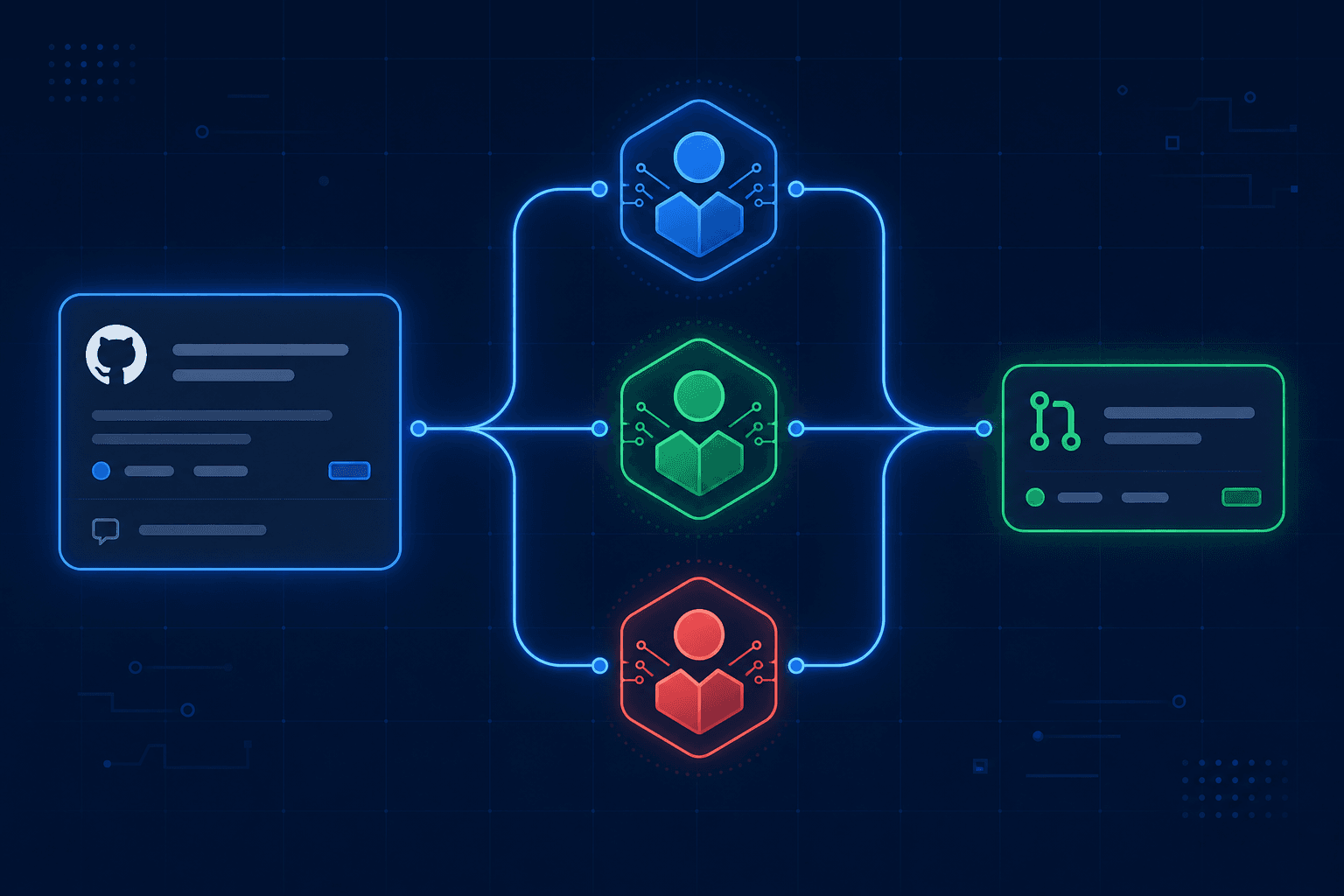
For about 2 years I've been building software with AI — pairing with assistants in the editor, iterating in long chat threads, shipping features faster than I could alone. That worked. But it didn't scale. Context lived in conversations, not in the repo. Changes were bundled. Rollback meant archaeology.
The next step wasn't a smarter prompt. It was architecture: treat AI agents like engineers on a team, give them a ticket queue, enforce small PRs, and keep humans at the merge gate.
This post documents what I shipped on Fasted — a two-stage GitHub issue automation pipeline (issue #30) — and what happened when I ran it in production for the first time.
The pipeline is available as open source: issue-bench — use the template or run npx issue-bench init to add it to your repo.
The Problem I'm Solving
Solo development with AI assistants has a ceiling:
- No shared queue. Work happens wherever you remember to ask — not where the team (even a team of one human and several agents) can see status.
- No audit trail. Decisions disappear into chat history instead of issue comments and PR descriptions.
- No revert boundary. A "quick fix" session can touch twelve files across three concerns. Rolling back one idea means untangling everything else.
- No human checkpoints. Either the agent runs unsupervised, or you babysit every keystroke.
I wanted a system where I could describe intent once, get a reviewable spec, approve implementation explicitly, and receive a small PR I could merge, revise, or revert — with the entire journey visible on the GitHub issue.
The Meta Approach: A Team, Not a Chatbot
In an earlier post I described building AI with AI — Claude as architect, ChatGPT as coder, Cursor as editor. That was collaboration inside my head.
This pipeline externalizes that collaboration into roles with handoffs:
| Role | Who | Job |
|---|---|---|
| Product / triage | Human (me) | Write the issue, add labels, merge PRs |
| Spec writer | OpenAI via GitHub Action | Read repo context, post acceptance criteria |
| Implementer | Cursor cloud agent | Branch, code, test, open PR |
| QA / release | Human (me) | Review diff, screenshots, CI — then merge |
Each role produces an artifact the next role consumes. Nothing skips a gate unless I remove the gate.
That's the difference between "I asked Cursor to fix something" and "I run a team of engineers in tandem."
Architecture Overview
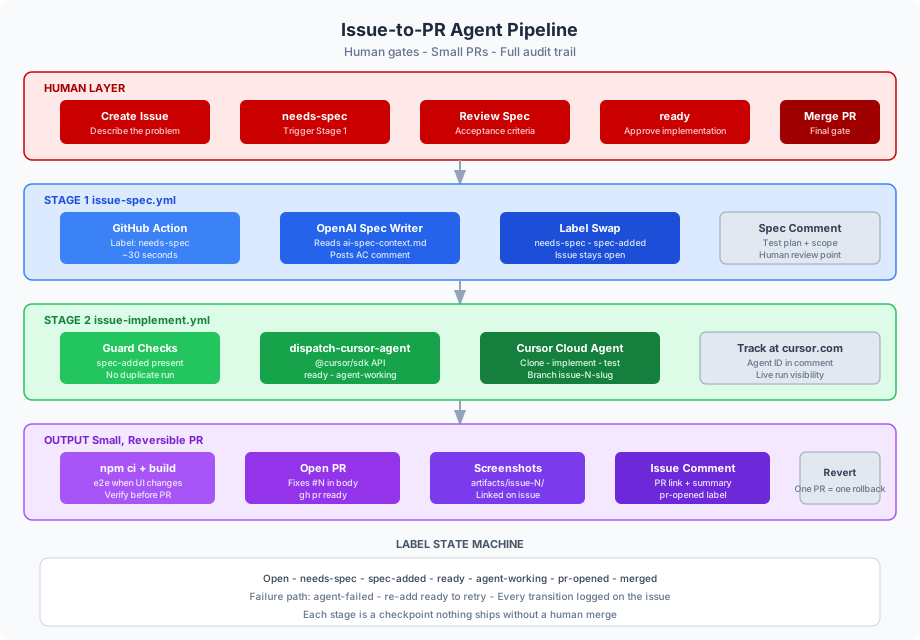
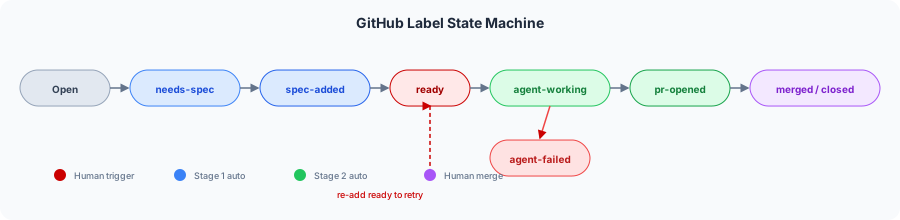
The pipeline has two stages, both triggered by GitHub labels:
Issue → needs-spec → [Stage 1: OpenAI spec] → spec-added
     → ready        → [Stage 2: Cursor agent] → pr-opened → human merge
Stage 1 — Spec generation (issue-spec.yml)
When I add the needs-spec label:
- A GitHub Action reads
.github/ai-spec-context.md(stack, conventions, constraints) - OpenAI generates acceptance criteria from the issue title and body
- The spec posts as an issue comment
- Labels swap automatically:
needs-spec→spec-added
This takes about 30 seconds. I read the comment, edit the issue if needed, and decide whether to proceed.
Stage 2 — Implementation (issue-implement.yml)
When I add ready:
- Guards verify
spec-addedis present and no agent is already running - Labels swap:
ready→agent-working scripts/dispatch-cursor-agent.mjslaunches a Cursor cloud agent via@cursor/sdk- The agent clones the repo, reads
.github/ai-implement-context.mdplus the issue and all comments - It implements on branch
issue-{N}-{slug}, runsnpm ci && npm run build(and e2e for UI changes) - It opens a PR with
Fixes #{N}, marks it ready for review, posts screenshots if UI changed, and updates labels topr-opened
I track live runs at cursor.com/agents. The issue gets a comment with the agent ID and link.
What gets built (the plumbing)
| File | Purpose |
|---|---|
.github/workflows/issue-spec.yml | Stage 1: label → OpenAI spec |
.github/workflows/issue-implement.yml | Stage 2: label → cloud agent dispatch |
.github/ai-spec-context.md | Repo context for spec generation |
.github/ai-implement-context.md | Senior-engineer prompt + completion checklist |
scripts/dispatch-cursor-agent.mjs | Cursor SDK dispatch script |
Secrets: OPENAI_API_KEY (Stage 1), CURSOR_API_KEY (Stage 2), plus GitHub ↔ Cursor repo access for cloud agents.
Why Small PRs Are the Architecture
The agent is instructed to implement minimally — match repo conventions, one issue per branch, no drive-by refactors. The PR body includes a test plan. UI changes require screenshots committed to artifacts/issue-{N}/.
This isn't politeness. It's operational design:
- Revert = one
git revertmerge. If the verse-of-the-day label change is wrong, I revert PR #33 — not a week's worth of mixed work. - Review = bounded diff. 183 additions across 8 files is reviewable in ten minutes. A "fix everything" session is not.
- Traceability = issue ↔ branch ↔ PR.
Fixes #16links the merge to the original intent. Labels tell me where it stalled. - Parallel-ready. Once this pattern is stable, multiple issues can queue. Each gets its own branch and PR. Conflicts surface at merge time, not inside one giant changeset.
The architecture of the future isn't "AI writes all the code." It's AI writes small, reviewable units of code inside a system humans control.
First Production Test: Issue #16 → PR #33
I ran the pipeline end-to-end on a real feature: rename a journal field to "VERSE of the Day" and link the scripture reference to Bible.com.
| Step | Result |
|---|---|
| GitHub Action dispatch | ✅ ~26 seconds |
| Cloud agent implementation | ✅ PR #33 — 183 additions, 8 files |
| Build + e2e tests | ✅ Agent ran npm run build and journal e2e suite |
| Draft PR → ready for review | ❌ Missed initially — now in completion checklist |
| Screenshots on issue | ❌ Missed initially — now mandatory for UI changes |
Issue comment + pr-opened label | ❌ Missed initially — fixed manually; now in checklist |
The agent did the hard part: new VerseOfTheDayLabel component, Bible.com URL helpers, updated e2e selectors, markdown export label. The gaps were process, not capability — draft PRs, post-merge housekeeping. I tightened .github/ai-implement-context.md in commit 6fc4e51 so the next run closes the loop automatically.
That's the feedback loop this architecture enables: ship → observe where the agent stopped short → encode the fix in repo context → retry.
Working in Tandem
Here's what a typical session looks like now:
- I create an issue with a clear description while building something else locally
- I add
needs-specand go back to my work — the spec comment arrives before I finish reading a few reddit posts - I skim acceptance criteria on my phone, add
readyif it looks right - The cloud agent runs while I review another PR or write a blog post (like this one)
- When
pr-openedappears — or the agent comments with the link — I review a focused diff, check screenshots, merge or request changes
I'm not pair-programming every line. I'm managing a bench — dispatching work, reviewing output, merging when quality meets the bar. The agents don't replace judgment. They compress implementation latency.
Guards, Failures, and Retry
The pipeline fails safely:
- Stage 2 won't dispatch without
spec-added - It won't double-dispatch if
agent-workingorpr-openedis already set - On dispatch failure, labels restore to
ready+agent-failedso I can retry - If the agent is blocked, it comments on the issue and does not open a half-baked PR
Every transition is visible as a label change and/or comment. When something goes wrong, I know which stage failed — not "the AI broke."
Lessons Learned
GitHub is the project manager. Issues, labels, comments, Actions logs, and PRs are the coordination layer. Don't build a custom dashboard until you've exhausted the platform you already pay for.
Context files are the employee handbook. ai-spec-context.md and ai-implement-context.md are living documents. Every production gap becomes a new checklist item. The agents get better when the repo gets better, not when you craft a one-off mega-prompt.
Human gates are features, not friction. needs-spec and ready are intentional pauses. They cost seconds and prevent expensive wrong-direction runs.
Completion checklists beat hope. "Please comment on the issue when done" failed once. A numbered checklist in the implement context file is enforceable — the agent reads it every run.
Small PRs are how you trust automation. I wouldn't auto-merge a 2,000-line diff. I will review and merge 183 lines that fix one issue with tests attached.
What's Next
The pipeline is live on main. Follow-ups I'm tracking:
- Optional
implement-nowlabel as a second spend gate before cloud agent dispatch - Follow-up GitHub Action when a PR opens to fix labels if the agent skips post-PR steps
- Cursor cloud dev environment for faster Playwright runs (#31)
- Update spec context to reflect Supabase (still mentions PocketBase from an earlier stack)
The longer vision: multiple agents on a queue, each producing small PRs, humans merging in priority order — a software team where the bottleneck moves from "typing code" to "deciding what to build next."
That's the architecture I think we're heading toward. Not fewer humans. Humans at the decision layer, agents at the execution layer, Git as the contract between them.
Human Reflections
The moment this clicked wasn't when the agent opened PR #33. It was when I added ready, left my desk, and came back to a branch with passing e2e tests and a PR description better structured than half the ones I've written tired at midnight.
I still merged manually. I still fixed the labels the agent missed. But the shape of the work was right one issue, one branch, one revert boundary. That's how teams ship. I just built the team out of labels and API keys.
The hard part wasn't the Cursor SDK or the GitHub Action YAML. It was accepting that my job is changing: less typing, more triage, review, and context curation. The repo's .github/ai-implement-context.md file is now as important as any component. That's not a downgrade. That's a promotion to engineering manager — with a very fast bench.
More about the implementation on GitHub.
Building AI with AI Series
Part 4 of 6