Introduction
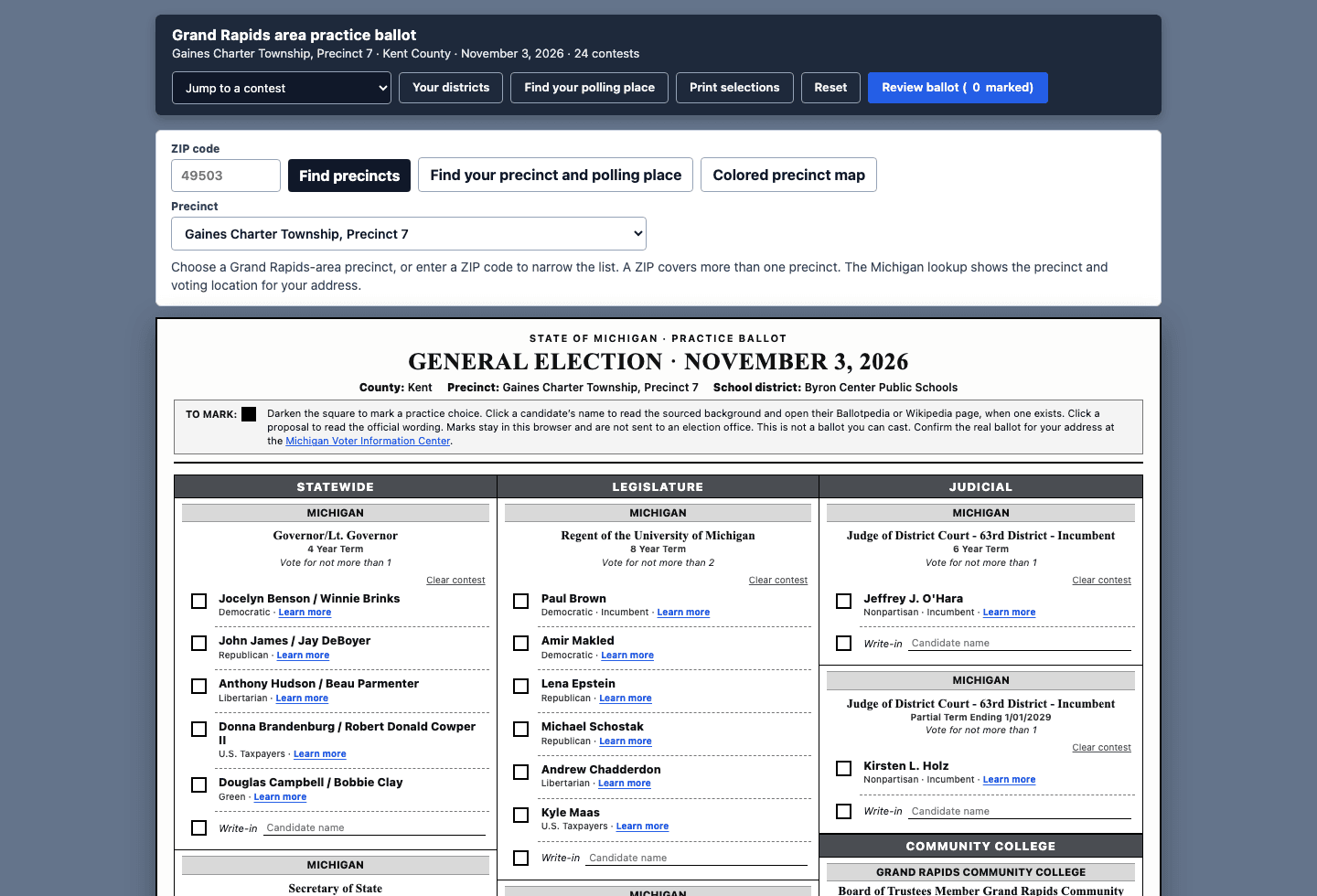
Grand Rapids Practice Ballot is one HTML file. It loads data/ballot.json and data/precincts.json, and if those requests fail it reads the same JSON embedded in the page. There is no account, no build step, and no server-side store.
Live: https://ballot.360web.cloud
Source: mitchelldawkinsjr/kent-elections
The product story is in A Ballot You Can Actually Read.
Status: Active — live at ballot.360web.cloud. The same files run locally with python3 -m http.server. nginx serves them from the kent-ballot image on the VPS.
This is a reference guide for the November 3, 2026 general election. It is not a ballot an election office will count. The official ballot for an address is at the Michigan Voter Information Center.
Problem & Solution
The Problem
- One county PDF lists every contest in Kent County, including offices a given precinct will not see
- Millage questions are written as a rate per thousand dollars of taxable value
- A guide per precinct would copy the statewide races 132 times and then go stale
- An account would turn practice marks into a stored vote
The Solution
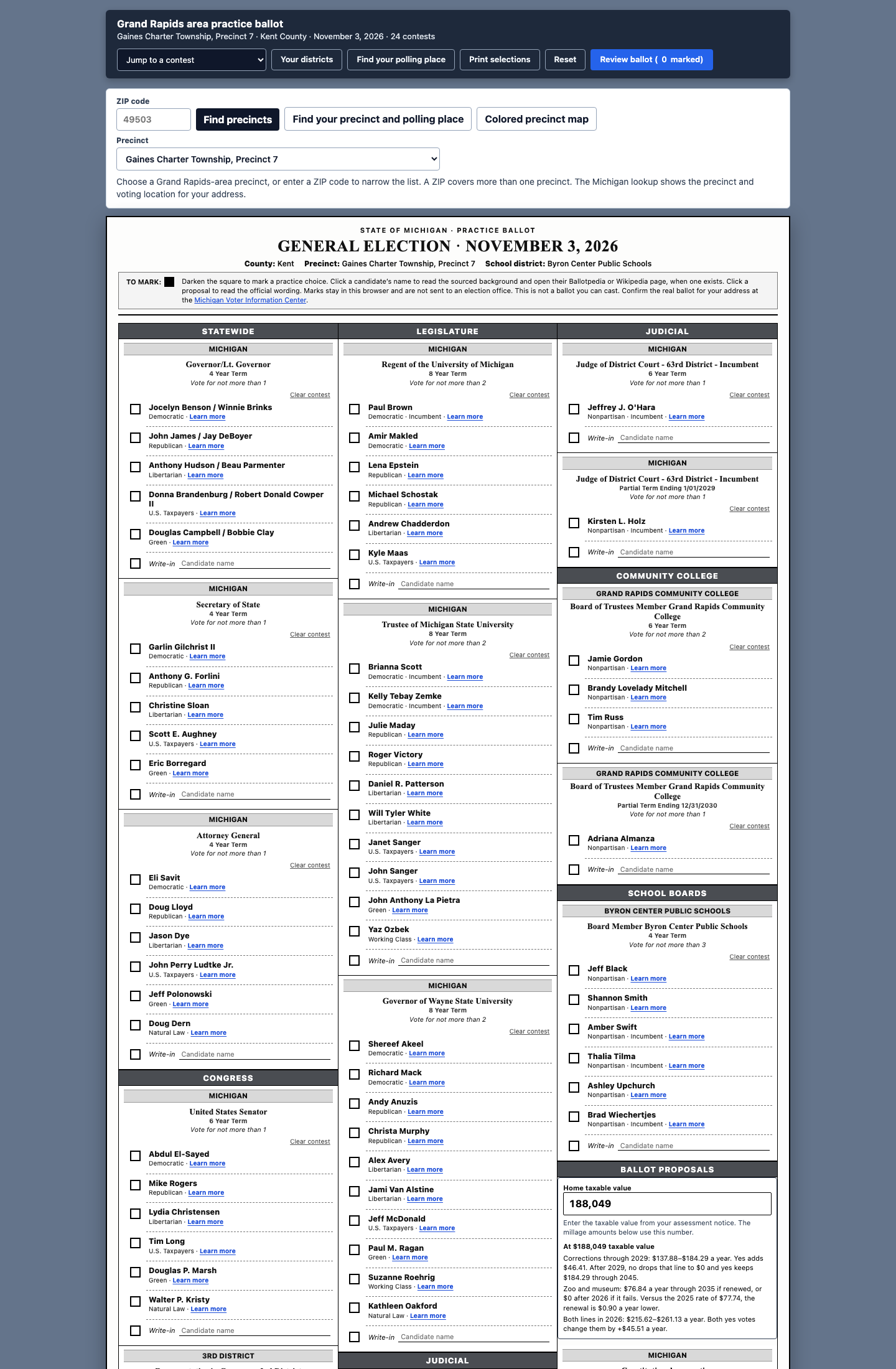
- One contest list of 24 races, each tagged with a scope
- One precinct catalog of 132 precincts, each a list of scopes
prepare()turns candidates into options and proposals into Yes / Nocolumnize()balances three columns by a rough height, with proposals weighted heavierlocalStoragekeeps marks per precinct on this device
Architecture Overview
| Layer | Files | Role |
|---|---|---|
| Page | index.html | Layout, precinct filter, marks, review, print, millage math |
| Contests | data/ballot.json | Offices and proposals, notes, filings, outbound links |
| Places | data/precincts.json | Municipality, ZIP codes, school label, scopes, district lines |
| Notes | scripts/build_guide.py | Writes short sourced biographies back into ballot.json |
| Edge | nginx.conf, Dockerfile | Static files, Cache-Control: no-store on /data/ |
| Host | docker-compose.prod.yml | Container kent-ballot-app on 360ws-network |
loadJson() fetches the file. On any failure it parses the <script type="application/json"> block with the same id. Opening index.html as a file still renders. Serving the directory still picks up edits to the JSON without a rebuild of the HTML.
Scopes, not copies
A contest carries scope. Statewide offices and the two statewide proposals use statewide. Kent County offices and the two millages use kent. Congress, the state legislature, the appeals court, the district court, Grand Rapids Community College, and the Byron Center school board each have their own scope.
applyPrecinct() keeps races where precinct.scopes includes race.scope. The default precinct is gaines-charter-township-precinct-7. The last choice is stored as gr-precinct-id.
ZIP lookup filters the <select>. If several precincts share the ZIP, the ballot stays on the current precinct until one is chosen. If the precinct is missing a House, Senate, school, or district-court scope, a line on the sheet says those contests are not in this guide yet.
Nine municipalities are in the catalog today: Grand Rapids City (59 precincts), Wyoming, Kentwood, Gaines Charter Township, Byron Township, Grand Rapids Charter Township, Grandville, Walker, and East Grand Rapids.
Marks
prepare() assigns option ids. A proposal becomes { id: "yes" } and { id: "no" }, with write-in off. An office maps each candidate to a string index and allows a write-in. voteLimit decides the control: one choice is a radio, more than one is a checkbox. The State Board, the three university boards, the Supreme Court, the appeals court, the circuit court, one GRCC seat, and the Byron Center board all allow more than one mark.
State lives in memory as { selections, writeInText } per race, then persist() writes:
{ "v": 1, "marks": { "race-1": { "selections": ["0"], "writeInText": "" } } }
The key is gr-practice-ballot:<precinct id>. Gaines Precinct 7 still reads the older key precinct7-practice-ballot if the new key is empty. Reset clears the current precinct only. Review lists every contest, including blanks, and print uses a sheet that is hidden on screen.
Millage math
Two contests carry a levy object: kind of increase or renewal, proposedMills, baselineMills, and the year spans. The taxable value is one number for the page, stored as precinct7-taxable-value.
One mill is $1 per $1,000 of taxable value. The page works in cents:
function taxCents(taxable, mills) {
  return Math.round(taxable * mills / 10);
}
taxable * mills / 1000 is the dollar amount. Dividing by 10 instead yields cents, and Math.round keeps the displayed bill on a cent. levyFigures() returns the yes amount, the baseline amount, and delta.
An increase headline is the extra annual bill, plus that gap divided by 12. The corrections levy is 0.98 mill from 2026 through 2045, against a 0.7332 mill baseline. A renewal headline is the yes bill through the proposed span. The zoo and museum levy is 0.4086 mill from 2026 through 2035, next to the 2025 rate of 0.4134 mill. The copy for a no vote says the line ends. It does not pretend the old rate continues.
Sources and deploy
Candidate notes are short and tied to a public page: Ballotpedia, Wikipedia, Michigan Public, Bridge Michigan, MLive, and the county list for the filing line. scripts/build_guide.py is the place those sentences are edited. Home addresses are not in the file. If a biography could not be checked, the card says so instead of inventing one.
Production is the same static tree in nginx. Nginx Proxy Manager terminates HTTPS for ballot.360web.cloud and forwards to kent-ballot-app:80. Port 8033 on the host is the direct check. JSON responses send Cache-Control: no-store so a data edit is visible on the next load.