Thinker: Replace Doomscrolling with Microlearning
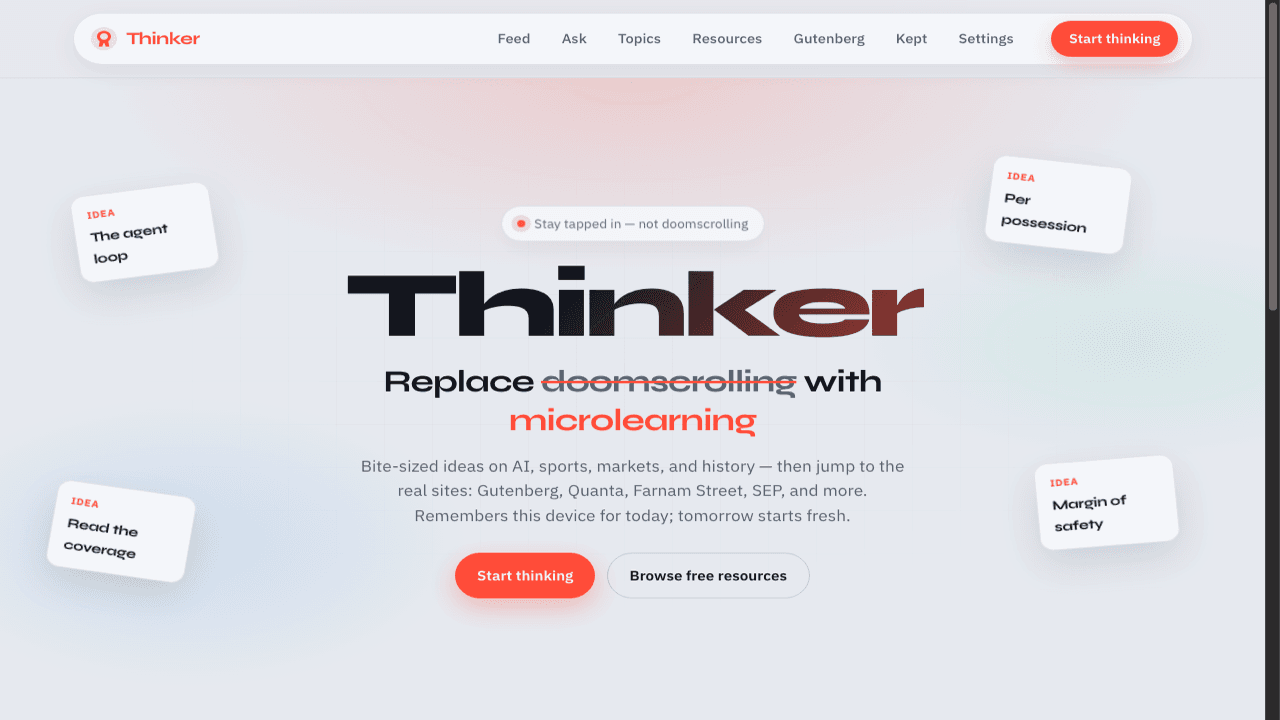
Phone in hand. Thumb on autopilot. Twenty minutes gone and I couldn't name a single useful thing I'd learned.
That loop is the product most social feeds are optimized for. I wanted the opposite: stay tapped in without doomscrolling — short ideas on AI, sports, markets, and history, then a clean jump to the real source (Gutenberg, Quanta, Farnam Street, SEP) instead of another endless tab.
So I shipped Thinker — a Progressive Web App you can install to the home screen. Technical deep dive: Thinker project page.
The product in one sentence
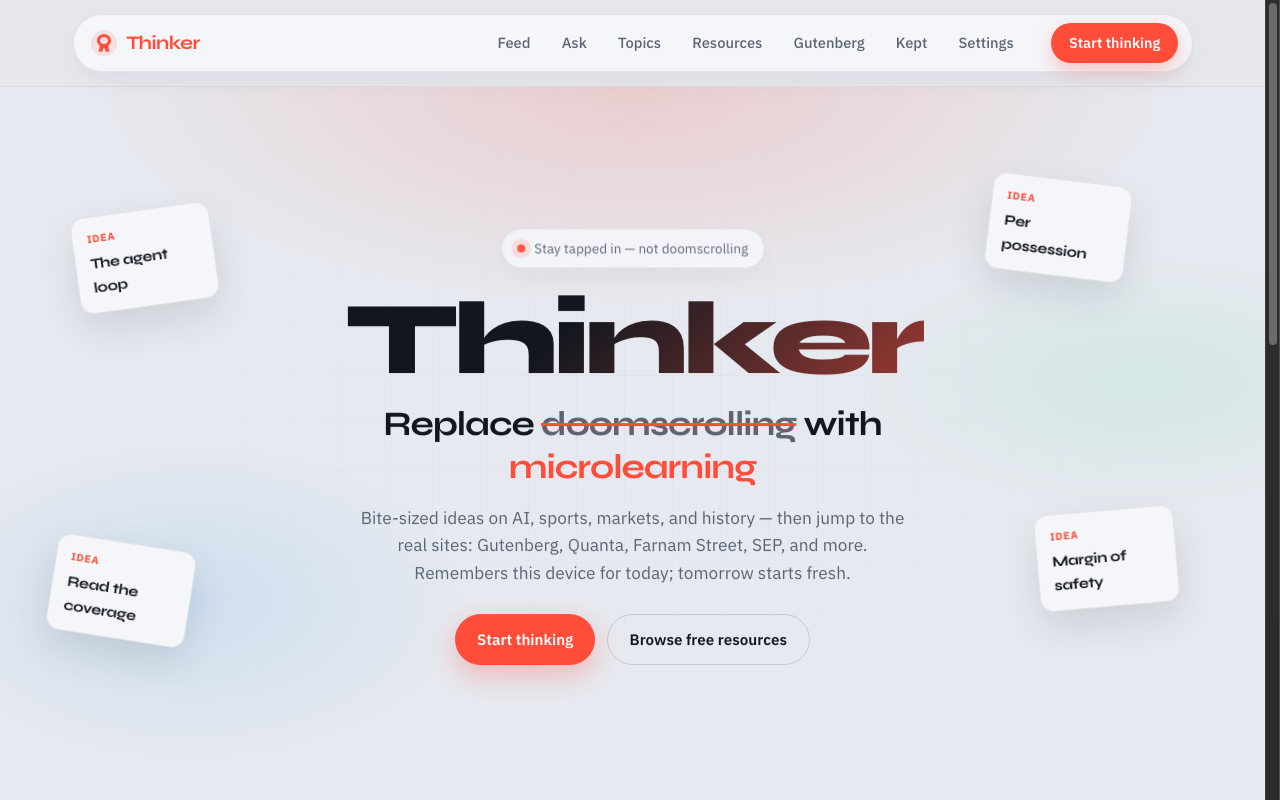
One idea at a time. Keep what matters. Open the source when you want depth. Forget the rest when the day rolls over.
Why not another reading list?
Bookmarks pile up. RSS readers become inbox zero theater. “Read later” becomes never.
Thinker’s bet is session design, not another archive:
| Behavior | Social feed | Thinker |
|---|---|---|
| Unit of attention | Infinite scroll | One card |
| Memory | Algorithmic trap | Device-local day session |
| Destination | More of the same app | Outbound to free source sites |
| Freshness | Engagement bait | News expires; tomorrow reshuffles |
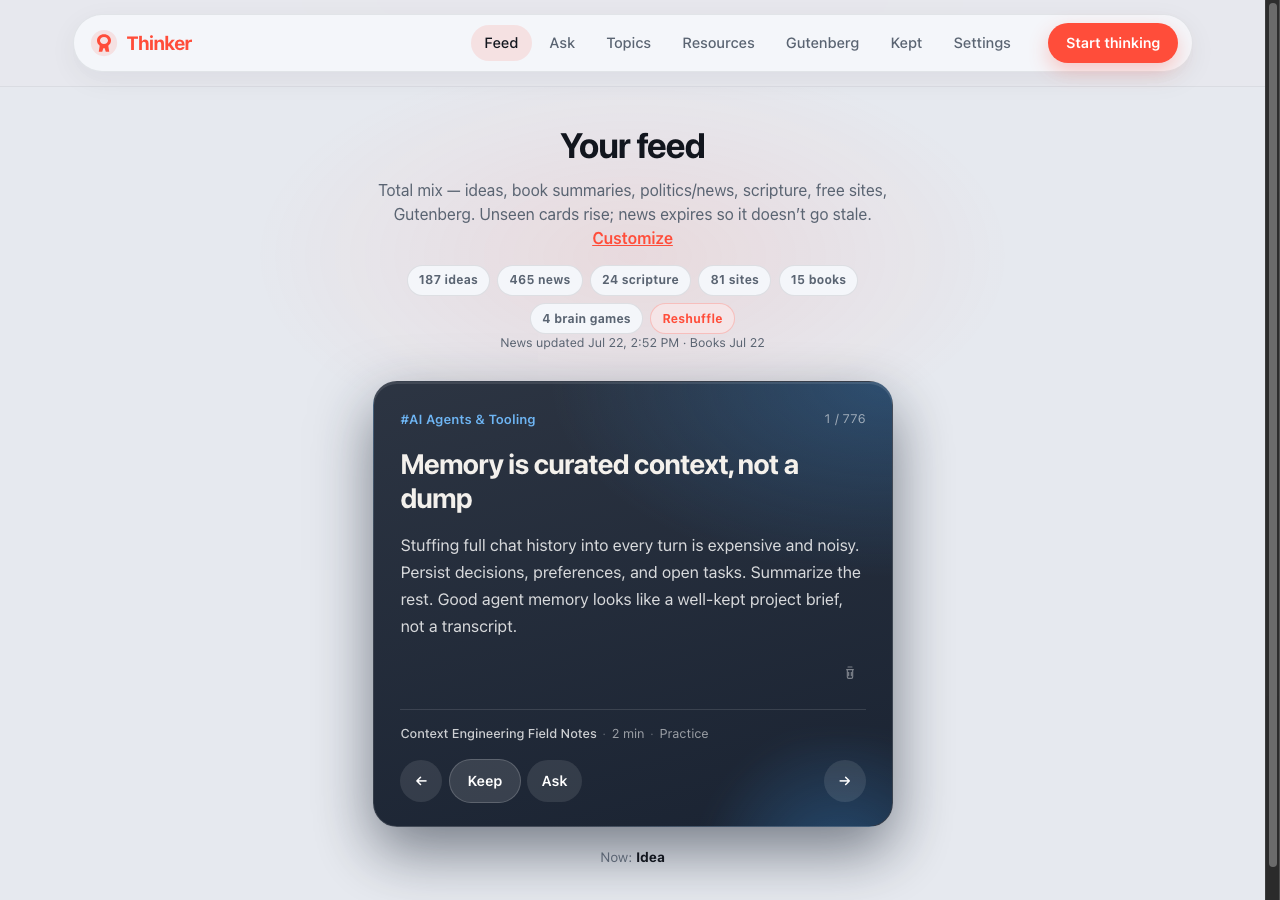
The feed is a deck, not a wall. You swipe through ideas, news, scripture, curated free sites, Gutenberg books, and a few brain games — interleaved so no single stream owns the night.
What’s in the mix
Live on the device today (counts move as ingest runs):
- Ideas — curated micro-lessons across 14 topics (AI agents, LLMs, RAG, NBA, WNBA, football film, finance, mental models, and more)
- News — RSS-ingested items with expiry so headlines don’t go stale
- Scripture — short passages for slower reading
- Free sites — a Knowledge Lover / Go Highbrow–style shelf
- Gutenberg — public-domain books linked by shelf and topic
- Brain games — tiny breaks that still feel intentional
Topics are first-class. Filter the feed to #AI Agents & Tooling or #Finance & Markets when you want a lane; leave it open when you want the full mix.
Ask without inventing the internet
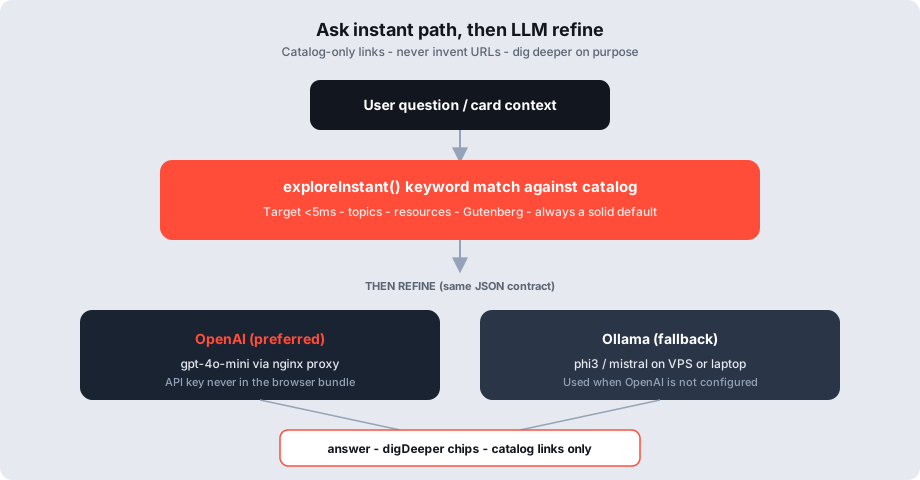
Every card can open Ask. The important design choice: the model is a research guide over Thinker’s catalog, not a free-roaming chatbot.
- Instant path — keyword match against topics, resources, and Gutenberg (<5ms)
- LLM refine — OpenAI (
gpt-4o-mini) preferred, Ollama fallback - Contract — short answer, dig-deeper chips, links only from the catalog
The API key never ships in the browser bundle. Nginx on the VPS injects Authorization for /api/openai/*. If OpenAI isn’t configured, local/VPS Ollama still works. If neither is up, the rest of the app is fine — Ask falls back to the instant catalog path.
Remembers today; tomorrow starts fresh
No accounts. No cloud sync tax. Just localStorage with a deliberate split:
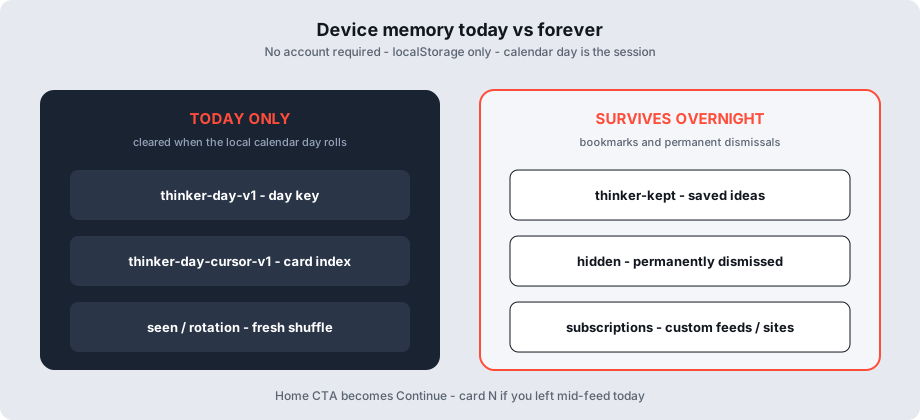
- Today only — day key, feed cursor, “seen” rotation
- Survives overnight — Kept bookmarks, permanent dismissals, custom subscriptions
Leave mid-feed and Home becomes Continue · card N. Wake up tomorrow and the deck is new again. Kept thoughts stay.
That matches how I actually want to use a phone: a daily practice, not a second inbox.
Built to run cheap on my own cloud
Thinker lives at thinker.360web.cloud on the same VPS pattern as my other 360 Web Solutions Cloud apps.
| Piece | Choice |
|---|---|
| UI | React 19 + Vite + TypeScript |
| Routing | react-router |
| Install | vite-plugin-pwa |
| Serve | nginx in Docker |
| Deploy | push main → GitHub Actions → VPS compose |
| Content refresh | weekly Actions ingest for news / scriptures / book ideas |
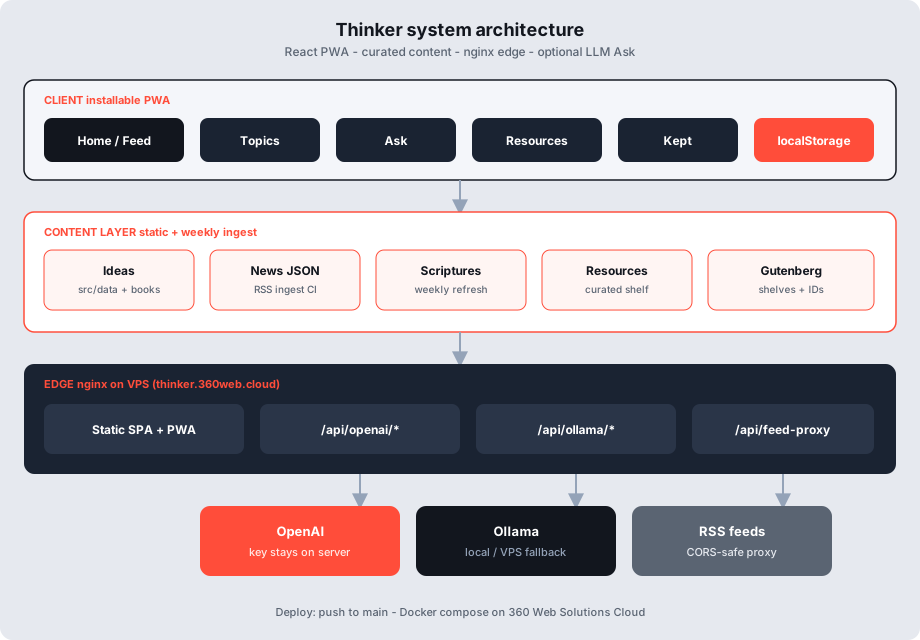
Content is mostly data in the repo (src/data/ plus public/content/*.json). Ingest scripts refresh JSON on a schedule; the client mixes it locally. No per-user database. No engagement graph. The cost curve stays flat.
Install it like an app
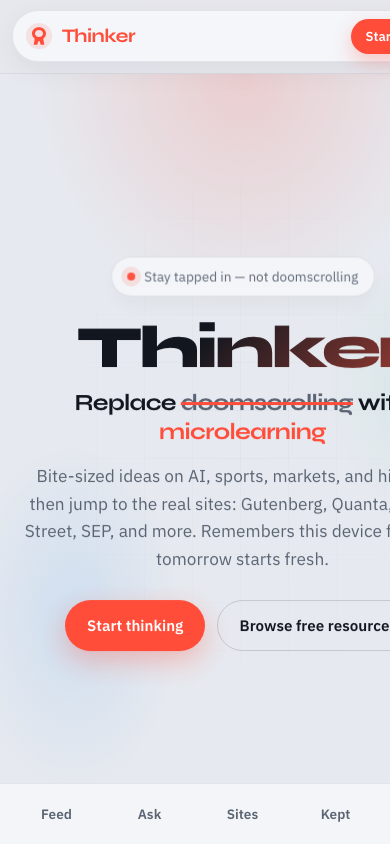
On your phone: open the live site → browser menu → Add to Home Screen. You get the offline shell, the thinking-man icon, and a feed that feels like a product — not a tab you lose.
What I’m optimizing for
Not “time on site.” Not streaks that guilt you.
I’m optimizing for minutes that leave a residue: a takeaway I can Keep, a source I actually open, a question Ask can route to SEP or Quanta instead of a comment section.
Human Reflections
Doomscrolling isn’t a willpower failure for me it’s a UI that wins by default. Thinker is me designing a different default: one card, one idea, one outbound link to something worth reading. If it only replaces ten minutes of empty scroll a day, it already paid for itself.
Try it: thinker.360web.cloud · Source: github.com/mitchelldawkinsjr/thinker · Architecture notes: /projects/thinker.
Low to No Cost Solutions Series
Part 5 of 6